Popular Posts
-
Rules for Breaking Lines in Tibetan Language Line-breaking and word-wrapping algorithms are important to text parsing as well as to text dis...
-
DHARMSALA, India — The question looms over this raggedy hillside town, a place where ancient mysticism constantly brushes against the realit...
-
His Holiness the Dalai Lama often says: Hope for the best and prepare for the worst. This simple message inspires us to retain our vision of...
-
While U.S. celebrations of the Dalai Lama's birthday were quite public and high-profile, they were muted for tens of thousands of his fo...
-
NEW DELHI — Police overpowered a young Tibetan exile who set himself on fire outside the Chinese Embassy in the Indian capital Friday in so...
-
Hi Friends converting TCRC/Monlam Bodyig 1 to Unicode are becoming easier now. There are 2 different ways to do it. 1. Way 1: Using UDP St...
-
The Tibetan spiritual leader who teaches age-old principles of peace and tolerance has gone high-tech, joining the online messaging service ...
-
BBC HARDtalk - Lobsang Sangay, Leader of the Tibetan exile movement, recently elected to head the Tibetan exile movement, and asks if Tibeta...
-
Source: News One Kathmandu, Sep 8 (IANS) Nearly six years after the then US president George W. Bush proposed to resettle in America around...
-
 By Associated Press, Published: November 1 KATMANDU, Nepal — Nepalese police detained more than 100 Tibetan exiles on Tuesday who had gat...


Thursday, September 27, 2012

Rules for Breaking Lines in Tibetan Language
Line-breaking and word-wrapping algorithms are important to text parsing as well as to text display. The rules for Asian languages, however, are quite different from the rules for Western languages. For example, unlike most Western written languages, Chinese, Japanese, Korean, Thai and Tibetan do not necessarily indicate the distinction between words by using spaces.
1. Start Microsoft Word 2010
2. Click File Tab (Home)
3 Click Advanced opten
4. Goto Layout Option (at the end )
5. Tick use line-breaking rules
Friday, November 4, 2011
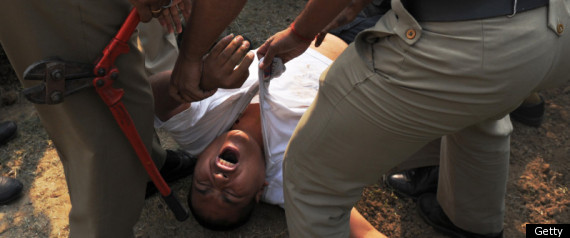
NEW DELHI — Police overpowered a young Tibetan exile who set himself on fire outside the Chinese Embassy in the Indian capital Friday in solidarity with Tibetans who self-immolated in China recently.
Police grabbed 25-year-old Sherab TseDor and put out the fire engulfing his trousers. He shouted "Free Tibet, Stop Killing in Tibet," as officers took him in a jeep to a hospital.
The man suffered minor burns, according to a police officer who spoke on condition of anonymity as he was not authorized to talk to reporters.
At least 11 Tibetans have set themselves on fire in China in recent months protesting Chinese restrictions on the Tibetan religion and culture. At least six died and the conditions of the others are unknown.
Although there is no tradition of self-immolation as a form of protest in Tibetan society, the suicides are seen as a sign of growing desperation in the ethnically Tibetan region, where tensions have been high since massive anti-government protests in 2008.
Tuesday, November 1, 2011

By Associated Press, Published: November 1
KATMANDU, Nepal — Nepalese police detained more than 100 Tibetan exiles on Tuesday who had gathered to pray for nine Tibetans who set themselves on fire in protest against Chinese rule.

A group of Tibetans including 150 monks were holding a prayer meeting on the outskirts of Katmandu in honor of the monks, former monks and a nun who have self-immolated since March in a restive Tibetan area of western China that has been under martial law-type police controls.

Aged in their late teens and twenties, at least five died of their injuries, while the condition of the other four is not known.
An Associated Press reporter saw police in riot gear enter the prayer meeting at the Tibetan Refugee Center and pull down a banner of their exiled spiritual leader, the Dalai Lama. This angered the Tibetans at the meeting who poured into the streets to protest. They chanted anti-China slogans calling for a “free Tibet” and for China to “leave our home.”

There have been several similar protests in the past in Nepal. The police generally don’t charge the protesters and they are usually released by nightfall.
The government has said it cannot allow protests to take place in Nepal against friendly nations, including China. Nepal is also under pressure from Chinese government to stop them.
Thousands of Tibetans live in Nepal and hundreds pass through Nepal on their way from Tibet to Dharmasala in India where the Dalai Lama lives.
Sunday, September 18, 2011
A 6.8 magnitude earthquake has been experienced in Kathmandu, Pokhara and other parts of the country. The earthquake occurred around 6.25 pm (this evening) and its reported that at least five people have been killed and several others have been injured. The epicentre of the earthquake is said to be somewhere along the Indo-Nepal border. Reported till now is of Magnitude 4.8 6.8 in SIKKIM, INDIA. Kathmandu, however experienced magnitude 6.8 on Richter Scale Earthquake.
The National Seismologic Centre (NSC) in Kathmandu said that the quake was measured 6.8 on the Richter scale with its epicentre in the border region of Taplejung of Nepal and Sikkim of India.
epicenter of the earthquake Earthquake in Sikkim, India shakes Kathmandu and other Parts of Nepal
The earthquake lasted for few seconds and people in Kathmandu are already full of panic.
We are following tweets to report damages and injuiries.
It has been reported that three persons have been injured as the wall of the British embassy to Nepal crumbled in Lainchaur.
According to Metropolitan police in Kathmandu, three persons (two adults and a child), were killed in the earthquake. They were killed when a compound wall fell on the car they were traveling at Laichchaur, Kathmandu.
Those killed have been identified as Sajan Shrestha, 36, and his eight-year-old daughter Anisha of Gorkha and one other man Bir Bahadur Majhi, according to police inspector Dan Bahadur Thapa, chief of Metropolitan Police Range, Sohrakhutte.
TV channels reported two persons were killed in Dharan. 20-year-old Santosh Pariyar and his six-year-old Kamal Pariyar died when the wall of their house collapsed, District Police Office Sunsari informed.
The Home Ministry came up with a statement saying the earthquake destroyed around 58 houses across the nation with 10 in the capital.
The Earthquake also interrupted the ongoing House session of CA in Kathmandu.
The National Seismologic Centre (NSC) in Kathmandu said that the quake was measured 6.8 on the Richter scale with its epicentre in the border region of Taplejung of Nepal and Sikkim of India.
epicenter of the earthquake Earthquake in Sikkim, India shakes Kathmandu and other Parts of Nepal
The earthquake lasted for few seconds and people in Kathmandu are already full of panic.
We are following tweets to report damages and injuiries.
It has been reported that three persons have been injured as the wall of the British embassy to Nepal crumbled in Lainchaur.
According to Metropolitan police in Kathmandu, three persons (two adults and a child), were killed in the earthquake. They were killed when a compound wall fell on the car they were traveling at Laichchaur, Kathmandu.
Those killed have been identified as Sajan Shrestha, 36, and his eight-year-old daughter Anisha of Gorkha and one other man Bir Bahadur Majhi, according to police inspector Dan Bahadur Thapa, chief of Metropolitan Police Range, Sohrakhutte.
TV channels reported two persons were killed in Dharan. 20-year-old Santosh Pariyar and his six-year-old Kamal Pariyar died when the wall of their house collapsed, District Police Office Sunsari informed.
The Home Ministry came up with a statement saying the earthquake destroyed around 58 houses across the nation with 10 in the capital.
The Earthquake also interrupted the ongoing House session of CA in Kathmandu.
Thursday, September 8, 2011
Source: News One
Kathmandu, Sep 8 (IANS) Nearly six years after the then US president George W. Bush proposed to resettle in America around 5,000 Tibetan refugees, regarded as living in danger in Nepal, there is still uncertainty and a shroud of secrecy surrounding the project.
In the past, the US successfully lobbied with the Nepal government to allow the over 100,000 Bhutanese refugees living in Nepal to be offered new homes in the US and other western countries. Subsequently, more than 50,000 refugees have already exited Nepal.
However, the Tibetan resettlement programme, though it involves a handful of refugees by comparison, continues to hang fire due to Nepal’s reluctance to ruffle the feathers of its giant northern neighbour China.
Soon after the Bush proposal was announced in September 2005, China objected to it, saying it would be tantamount to interfering in its internal affairs and violating Nepal’s One China policy, which regards Tibet to be an integral part of the Chinese republic.
Beijing considers there are no Tibetan refugees, only illegal migrants, who should be punished as per the law of the land.
However, two years later, there were indications that the dragon was mellowing.
In May 2007, the then Chinese ambassador to Nepal, Zheng Xianglin, held a meeting with the then American ambassador to Nepal, James F. Moriarty to discuss the Tibetan and other issues.
In a ‘frank conversation’, Zheng implied that ‘limited resettlement’ in the US might be possible. However, he cautioned Moriarty that ‘large and public resettlement plans were not a viable option’.
Emphasizing the importance of a ‘stable Tibet’, the Chinese envoy indicated that a ‘large’ US resettlement policy could have the potential fallout of encouraging outward migration from Tibet.
Answering diplomatically, the American ambassador said his government viewed Tibet as a part of China and only sought to assist the Tibetans who were stranded in Nepal, not create ‘a new wave of migration’.
The apparent Chinese thaw caught the Americans by surprise.
When Moriarty briefed his superiors in Washington, he said the Chinese envoy’s comments about Tibetan refugees were ‘most surprising’.
‘While we would not advise reading too much into his remarks, we will continue to explore with the government of Nepal the option of quietly resettling a few Tibetans,’ Moriarty said in the confidential document that is part of the recent cache published by WikiLeaks.
The US offer to resettle only 5,000 Tibetan refugees, while the diaspora has more than 20,000 members in Nepal, has been greeted with doubts by the Tibetans, who wonder why the US was ready to absorb 60,000 Bhutanese refugees but only a fraction of Tibetans.
They also feel that resettlement in the US for them would be tougher than resettling the Bhutanese refugees as tiny Bhutan could not bring the same political pressure on Nepal to scuttle the move as China could.
Kathmandu, Sep 8 (IANS) Nearly six years after the then US president George W. Bush proposed to resettle in America around 5,000 Tibetan refugees, regarded as living in danger in Nepal, there is still uncertainty and a shroud of secrecy surrounding the project.
In the past, the US successfully lobbied with the Nepal government to allow the over 100,000 Bhutanese refugees living in Nepal to be offered new homes in the US and other western countries. Subsequently, more than 50,000 refugees have already exited Nepal.
However, the Tibetan resettlement programme, though it involves a handful of refugees by comparison, continues to hang fire due to Nepal’s reluctance to ruffle the feathers of its giant northern neighbour China.
Soon after the Bush proposal was announced in September 2005, China objected to it, saying it would be tantamount to interfering in its internal affairs and violating Nepal’s One China policy, which regards Tibet to be an integral part of the Chinese republic.
Beijing considers there are no Tibetan refugees, only illegal migrants, who should be punished as per the law of the land.
However, two years later, there were indications that the dragon was mellowing.
In May 2007, the then Chinese ambassador to Nepal, Zheng Xianglin, held a meeting with the then American ambassador to Nepal, James F. Moriarty to discuss the Tibetan and other issues.
In a ‘frank conversation’, Zheng implied that ‘limited resettlement’ in the US might be possible. However, he cautioned Moriarty that ‘large and public resettlement plans were not a viable option’.
Emphasizing the importance of a ‘stable Tibet’, the Chinese envoy indicated that a ‘large’ US resettlement policy could have the potential fallout of encouraging outward migration from Tibet.
Answering diplomatically, the American ambassador said his government viewed Tibet as a part of China and only sought to assist the Tibetans who were stranded in Nepal, not create ‘a new wave of migration’.
The apparent Chinese thaw caught the Americans by surprise.
When Moriarty briefed his superiors in Washington, he said the Chinese envoy’s comments about Tibetan refugees were ‘most surprising’.
‘While we would not advise reading too much into his remarks, we will continue to explore with the government of Nepal the option of quietly resettling a few Tibetans,’ Moriarty said in the confidential document that is part of the recent cache published by WikiLeaks.
The US offer to resettle only 5,000 Tibetan refugees, while the diaspora has more than 20,000 members in Nepal, has been greeted with doubts by the Tibetans, who wonder why the US was ready to absorb 60,000 Bhutanese refugees but only a fraction of Tibetans.
They also feel that resettlement in the US for them would be tougher than resettling the Bhutanese refugees as tiny Bhutan could not bring the same political pressure on Nepal to scuttle the move as China could.
Subscribe to:
Comments (Atom)